


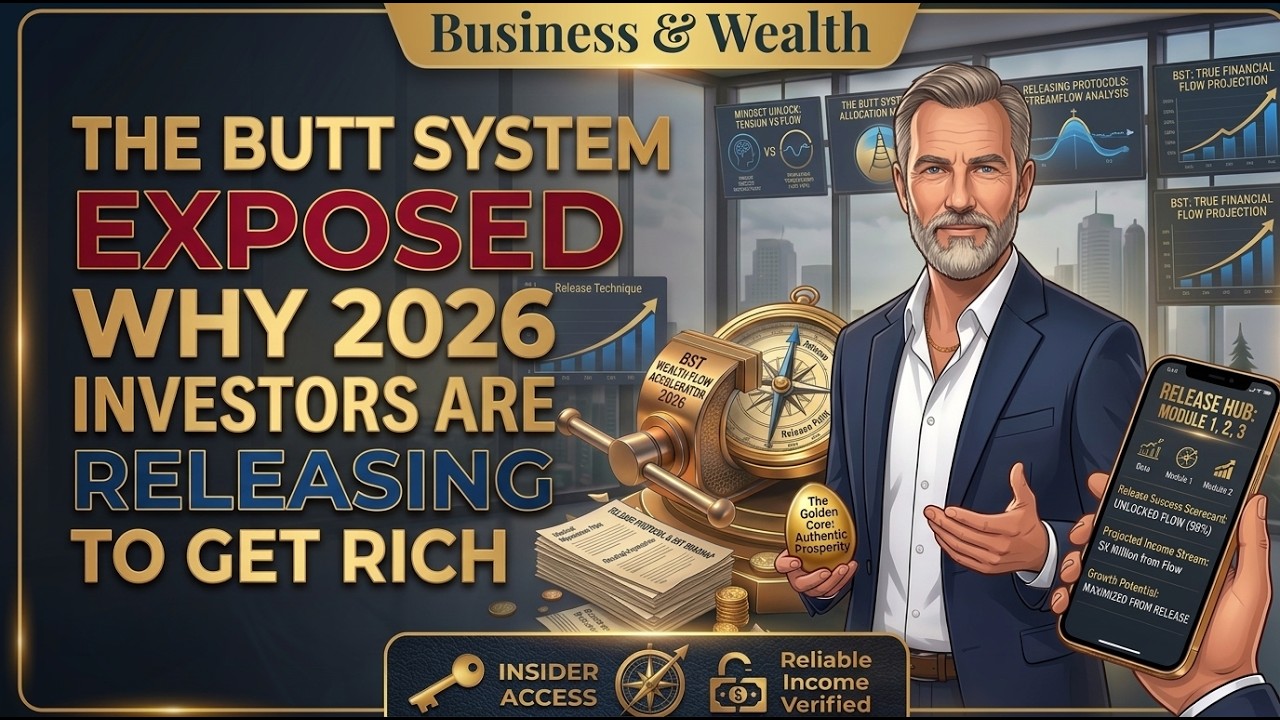
[Communicator]: In the high-stakes world of 2026 asset management, we are taught that hustle culture is the ultimate hedge. We’re told that if you are not grinding twenty hours a day on your trading platforms, you’re losing. But here is the cold, hard data: most traders fail not because of technical analysis, but because of their internal friction tax.
[Skeptic]: Wait, friction tax? Is this another mindset guru pitch?
[Communicator]: It is deeper than that. I’ve analyzed the Release Technique’s Butt System against mortgage-rate volatility and broad equity risk. The data shows that your subconscious I can’ts behave like bad debt on your internal balance sheet. Lester Levenson discovered that the harder you want a million dollars, the more you affirm its absence. Today, we are deconstructing how to liquidate those hidden blocks and move your portfolio into a state of having.
[Communicator]: This is the visual thesis of the episode: more force does not guarantee more return when internal friction is destroying net execution.
[Communicator]: Today’s masterpiece is broken into five strategic chapters to re-engineer your financial psyche.
[Communicator]: Chapter 1 is the subconscious audit. Chapter 2 is the Agflap liquidation. Chapter 3 is the want-versus-have hedge. Chapter 4 is the scale of action. Chapter 5 is twenty-four-seven market presence, the release door that remains open while you sleep.
[Analyst]: We will also reveal a specific risk factor most beginners miss: the lust loop, which can destroy your edge in crypto altcoin analysis if it is not hedged properly.
[Communicator]: Let’s get technical. The Butt System sounds like a gimmick, but for a physicist like Lester Levenson it was mechanical. The core theory is that releasing is the highest action an investor can take. Most of us spin in the mind, trying to solve a mortgage-rate crisis with the same mind that created the stress.
[Analyst]: From a data-science perspective, think of your mind as a processor. Your subconscious blocks are background processes consuming most of your RAM. If you are trying to execute a fast trade while your I can’t programs are running, you are going to experience latency. The Butt System is basically an End Task command for those programs.
[Communicator]: Donna calls these the yeah, buts. You say, I want to be a millionaire, but the subconscious whispers, I do not want the taxes, or people will come after me. Those are not random thoughts. They are literal impediments to your stated goal.
[Communicator]: Think of your subconscious blocks like a short position you forgot you had open. You are trying to go long on your life, but that old short is eating your margin. Releasing is the act of closing that short so you can finally capture the upside.
[Communicator]: Look at Lester Levenson in nineteen fifty-two. At forty-two, he had a massive heart attack and was given two weeks to live. He was a physicist and a millionaire, yet internal friction was killing him. By questioning his own mind and removing wanting, he did not just survive; he lived for decades more in freedom. He proved that when you stop wanting health and start being it, the body and the portfolio follow.
[Skeptic]: Wall Street reality check: in 2026 we call this emotional regulation. High-net-worth investors who cannot release fear of missing out during a crypto altcoin crash are the ones who get liquidated. The Butt System is a framework for maintaining imperturbability.
[Communicator]: To truly manage your assets, you must understand the Agflap scale. It is a hierarchy of energy that dictates your market effectiveness.
[Analyst]: AGFLAP stands for Apathy, Grief, Fear, Lust, Anger, and Pride. These are your liabilities. On the other side you have CAP: Courageousness, Acceptance, and Peace. Those are your equity states.
[Learner]: How does this affect something like my dividend investing portfolio?
[Analyst]: If you are in apathy, you do not even start. You say the market is rigged. If you are in fear, you sell at the bottom because you are terrified. But the most dangerous state for investors is lust.
[Communicator]: Exactly. Lust here is not just physical desire. It is the must-have-it energy, the greed and impatience that leads to overleveraging on a trading platform. Lust is the home of wanting, and wanting equals lack. If you want the profit too much, you are vibrating at not having it, and judgment gets cloudy.
[Communicator]: The hidden investing lesson is simple: your internal state sets the quality of your decision engine before a single order is placed.
[Communicator]: Moving from apathy to courageousness is like moving a stock from the penny-stock basement to the S and P five hundred. Apathy has zero liquidity. Courageousness is where the volume is. You are finally willing to move without hesitation.
[Analyst]: I’ve found that when I release pride, the know-it-all energy, my forex price-action strategies become more accurate. I stop trying to be right and start being in tune with what the market is doing. Pride is a stuck place because you are unwilling to change. In a 2026 market, if you do not move, you get crushed.
[Skeptic]: The risk here is spiritual bypass. You cannot just release your way out of a bad mortgage rate if you do not take the courageous action to refinance. Releasing gives you clarity to act. It does not replace action.
[Communicator]: We’ve audited the subconscious and categorized the Agflap liabilities. Now we move to the want-versus-have hedge, the mechanism behind attracting passive income without pressure.
[Communicator]: To master your portfolio, you must first master the mechanics of wanting. Wanting is not poetic language here. It is literal lack. The moment you obsess over a specific return, a target, or a perfect exit, you are broadcasting that you do not have it now. That creates internal deprivation, and deprivation distorts execution. [Analyst]: Technically, this is the desire trap. Attention gets pinned to a future state, so current cognition becomes unstable. You stop reading price objectively and start negotiating with reality. [Learner]: So the problem is not the goal itself, but the emotional dependency attached to it? [Communicator]: Exactly. Release the pain of wanting, hold the picture of already having, and detach your happiness from the asset. [Skeptic]: If you need the trade to work, you are already compromised.
[Analyst]: Wanting is like trying to execute a massive buy order on a thin altcoin. Your urgency moves the market against you. The more desperate the fill, the worse the entry. [Communicator]: Releasing the want is not canceling the position. It is executing like an iceberg order: still intentional, but not broadcasting desperation. [Learner]: So having is operationally quieter? [Analyst]: Yes. Less emotional footprint, less cognitive slippage, better timing. [Skeptic]: And the hedge here is discipline, not magical thinking. You still need a thesis, risk sizing, and a stop. [Mastermind]: Capital preservation begins internally. Investors often destroy more return through emotional market impact than through fees.
[Communicator]: The source material gives a direct case study: students reported receiving nine thousand and ten thousand dollars after releasing the want for money rather than tightening around it. Eric wanted ten thousand or more with ease. By letting the wanting feeling surface and evaporate, he moved into neutrality, and resistance dropped. [Analyst]: Operationally, neutrality frees bandwidth. [Learner]: That sounds like the difference between checking a price ten times a day and simply holding the plan. [Communicator]: Exactly. The proof-of-work example in gold shows the same thing. Releasing the need for gold to hit a specific number reduced stress, stabilized behavior, and prevented emotional exits. [Skeptic]: Risk assessment: do not confuse calm with laziness. You still audit rates, cap rates, entries, and macro drivers. [Mastermind]: The mature investor metabolizes desire, then acts from sufficiency. That is the hedge.
[Communicator]: To understand asset allocation, you must understand energy allocation. The Scale of Action is a diagnostic roadmap for why trades fail before they fail on paper. At the bottom is Apathy, where desire is dead and movement is dead. Then comes Grief, where the investor wants rescue, a bailout, or a guru. These are high-friction, low-return states. [Analyst]: Moving through Fear and Lust, wanting intensifies. Anger strikes at the market. Pride freezes adaptation because being right becomes more important than compounding. [Learner]: So the scale is a map of trade quality? [Communicator]: Exactly. Real ROI begins at Courageousness, where movement returns. Acceptance and Peace remove slippage from action. [Skeptic]: Below Courageousness, you are not investing. You are gambling with contaminated data.
[Analyst]: Apathy is a delisted stock. Nothing moves. Pride is a trading halt. You are trapped and cannot exit because identity is locked to the position. Acceptance and Peace behave like the deepest liquidity in the world. [Communicator]: That is why this scale is really an ROI map. It tells you how expensive your internal state is before fees or tax drag. [Learner]: Is that why some people with good analysis still lose? [Analyst]: Yes. Their emotional state injects latency and overreaction into every step. [Skeptic]: The most dangerous plateau is Pride because it masquerades as conviction. [Mastermind]: Liquidity, humility, and adaptability belong to the same family.
[Communicator]: The source case study of Vicki shows the same mechanism outside markets. When she stopped fighting the problem and released the want to force an outcome, energy became available for actual healing. [Analyst]: The investing proof-of-work is equally sharp. During a mortgage-rate spike, the REIT book came under pressure. Pride wanted to hold. Anger wanted to fight. Fear wanted to dump at the worst point. By moving into Acceptance, the correct rebalance became obvious: liquidate laggards, rotate into high-yield dividend exposure, preserve capital, and recover clarity. [Learner]: So Peace is not passive. It is the condition that makes decisive action obvious. [Communicator]: Exactly. [Skeptic]: Final risk assessment for this chapter: if you are below Courageousness, your data is compromised. [Mastermind]: Capital preservation starts with internal state, asset allocation follows, and disciplined adaptation compounds the edge.
[Skeptic]: Alright, let’s cut through the Zen and look at the Wall Street risk factors. Is this technique telling us to sit on our butts and wait for a Gold IRA to drop from the sky? In a 2026 economy defined by shifting mortgage rates and AI disruption, doing nothing looks a lot like apathy. [Communicator]: That is the primary BS risk we need to deconstruct. The central confusion is subconscious mimicry, where an investor mistakes the low-energy state of defeat for the high-frequency state of peace. In apathy, you do not act because you feel beaten. In peace, you act with near-total efficiency because there is no internal resistance. [Analyst]: On-screen, these two traders look similar. Operationally, they are worlds apart. One is disconnected and slow. The other is connected and decisive. [Learner]: So inactivity alone tells us nothing. [Skeptic]: Exactly. The question is whether stillness comes from surrender or surrendering responsibility.
[Analyst]: Lester’s insight was that limitations are conclusions the mind reaches from past data. If your mind has concluded that making money is hard, it will keep replaying that pattern regardless of how strong your stock-market analysis looks. The risk becomes acute in cryptocurrency trading. If you are releasing while holding a coin that is fundamentally decoupled from reality, you are not being imperturbable. You are being delusional. [Communicator]: This is where the framework must meet due diligence. Release does not erase fundamentals. It clears the static that prevents you from reading them accurately. [Skeptic]: A false conclusion plus a false asset is a lethal combination. [Learner]: So emotional clarity must still be paired with objective analysis.
[Communicator]: Think of this technique like an anti-virus for your internal operating system. The BS is the malware, the I can’ts and the yeah buts that slow everything down. Releasing is not deleting your trading platforms. It is clearing the cache and cookies so the platform runs at the speed of light. [Analyst]: Technically, this is a latency reduction model. It strips unnecessary emotional processing out of the execution path. [Learner]: So you are not removing the tool set. You are removing the contamination. [Skeptic]: Correct. If the system becomes cleaner, the edge becomes easier to express.
[Communicator]: Donna was already successful in the world before finding this technique. She initially thought manifesting language was nonsense. But by addressing subconscious programs around ease, she found that more could be achieved with less force. The source material points to students reporting nine thousand and ten thousand dollars after clearing internal wanting. [Analyst]: The mechanism is not magic. It is reduced contradiction. Once the system stops fighting itself, action quality rises and opportunities become visible. [Learner]: That sounds like efficiency rather than fantasy. [Communicator]: Exactly. [Skeptic]: And the practical verdict is this: stressing about mortgage rates does not improve the deal. Stress is just fear or anger clouding your vision. When the desire to control the uncontrollable drops, creative financing structures become visible.
[Communicator]: Here is the personal risk verdict. I have used this approach as a hedge against mortgage-rate volatility. The BS is believing that stressing about rates helps you find a better structure. It does not. Once I released the want to change what the Federal Reserve was doing, I stopped vibrating in lack and found a financing path that a stressed brain would have missed. [Analyst]: This is why risk evaluation must include internal state. Stress narrows optionality. Peace expands it. [Learner]: So the best deal can hide behind the wrong emotion. [Communicator]: Often, yes.
[Skeptic]: Final verdict. The Release Technique is a high-level psychological hedge. Use it to clear your I can’ts. But if you use it as an excuse to ignore your life-insurance premiums or stop analyzing your REITs, the market will punish you. This is about releasing only the feelings, not the responsibility. [Mastermind]: That is the consensus. Preserve clear perception, preserve capital, preserve accountability.
[Communicator]: We’ve liquidated internal debt and audited the energy scale. You now have the alpha that most investors lack: the ability to move from wanting to having. But there is still a final step. [Mastermind]: Without a precise algorithm, even a clean internal state can drift. The next layer is wording, architecture, and execution language.
[Communicator]: Before you close this video, do one esteem bath. For the next sixty seconds, let go of figuring out your portfolio and give yourself one hundred percent approval. Notice the shift in your energy. [Learner]: That lightness feels different. [Communicator]: Good. That lightness is the state where better stock-market decisions are made. [Skeptic]: Treat this as a calibration exercise, not a substitute for analysis.
[Communicator]: Mastering your internal state is step one. But step two is the algorithm. Most people fail because they write financial goals that their subconscious instantly rejects as a lie. In the next episode, we’re diving into The Goal Statement Algorithm. [Analyst]: We will break down the ten-step framework for phrasing goals so they bypass the BS detector and create one hundred percent confidence in asset execution. [Learner]: So this is where the wording becomes the leverage. [Communicator]: Exactly. You will see how to phrase an altcoin target or a real-estate cap rate so your mind says I can instead of yeah, but. [Mastermind]: That is the cliffhanger: same capital markets, better language architecture, higher execution quality.
[Communicator]: To accelerate your results, I’ve uploaded my raw thirty-day Release and ROI performance data, showing exactly how my dividend investing changed after I cleared my Agflap, at EDUxify.com. Download the Internal Balance Sheet template there. [Learner]: So the audience leaves with a practical tool, not just a theory. [Communicator]: Exactly. Subscribe, hit the bell, and join the one percent who trade from peace, not pressure. [Skeptic]: Use the tool, do the work, keep the responsibility. [Mastermind]: And arrive at the next episode ready to engineer goals that your subconscious will finally support.
[Communicator]: This episode was about clearing the friction tax. The next one is about writing your financial destiny without triggering your internal resistance. [Mastermind]: Preserve capital. Preserve clarity. We’ll see you in The Goal Statement Algorithm. [Skeptic]: And until then, release the feelings, not the responsibility.